Rent Seekers
I usually adopt RS as abbreviation of Remote Sensing. Within the present text, it’s something else.
Seaside from above Link to heading
I was attending a small science workshop, standing during a coffee break, somewhere on the large terrace of the venue, overseeing the sea, from a height. I was then chatting with some researcher, hereafter also identified as rent seeker (RS, sensu Taleb1) of one major national research institute, who was about to move to a more livable city (fair enough), in another instance of the same institute. I think I was talking about the challenges of starting what was going to become my 15-year-long soft money journey in Germany (before Earthgraph), a country where such duration of the above soft money grant hopping status is neither overly popular, nor really regulatorily compliant (Come fosse vicesindaco, con WissZeitVG a destra).
[earlier conversation] […]
RS: “Ah, but you should try and go under the wing of someone [powerful]”
Me: “wtf”
RS: “Well, but that’s a bit arrogant”
[Me kindly cutting the conversation and going back to the room where a number of academics was about to display some unique mix of ego and poor graphic design skills on PowerPoint].
Still, the person was kind and otherwise reasonably pleasant to chat with. I don’t much regret that I never met them again. I am connected to them via Linkedin - like with hundreds of other humans that mostly brag and otherwise don’t interact. Beyond a handful of (what I find) normal individuals on that platform, most of the non-dormant ones try to sell me something via DM, and a few (subpar) ghost. Perhaps they think I want to sell them something too? We all do, after all, in a way…
Recently I realised the RS’ headline reads something like very senior/something/director and a post was a selfie at a supposedly important event. So yes, it might be that for certain definitions of success, protection of armpit feathers is indeed useful.
Talking about feathers, after all - unrelated to the example, and the person above (as far as I know) - academic inbred is a thing2, so to say that body hair queuing can pay off, at least for some. In any case, looking at the calendar, RS might soon meet its attribute (R), but it’s plenty of RS, in all walks of life. Waiting in der Warteschlange.
To be fair, of course, one should not demonise corporate or public salarypersons, and I don’t do that (I recall several very decent, service/customer-oriented civil servants, together with several other RS). There is a somewhat slippery mat for anyone, though, between service and entitlement. Like - in other contexts - with risk + innovation vs. rapacious positional competitive advantage.
Glenda Link to heading
When I left the recipient of most of my 3rd party overhead during the late first quarter of the 2000s, I sent to most faculty I had interaction over the years a bye message, also borrowing Space Glenda (designed by Renèe French for Plan 9, Figure 1). A fair number answered. A few did not even bother to. I would not rule out cognitive degradation, after - then - 3 years of potentially repeated SARS on some. It can be just bad manners, though. Regardless, the widening incapability of dealing with epistolary communication goes well beyond this, and could be blamed too.

|
| Figure 1: Glenda (© R. French) in its planetary surface adaptation delivering a bye message. |
Ghosted (by ghosts) Link to heading
Before social media overwhelm and possible SARS-assisted brain depowering, one of the uncodified sins of academics was not to answer to emails. This probably originated from a few elements:
- Epistolary correspondence goes a long way in the past for research communication. After all short papers are called letters for a reason (such as the case of Newton, Darwin, etc. see also - not exhaustive - e.g. Mosley et al., 2003, Ogilvie, 2016, Oliveira and Barabási, 2005).
- In the 1990s email communication had already spread outside US academy, and fancy computer science labs, to reach each and every university, and it was quite functional.
- Academics had undoubtedly more time to read, reflect, and answer than other professional figures (some detractors would say too much).
- Last but not least, spam did not exist, for a short while.
This changed - for the worse - when instant messaging kicked in. And spam. And phishing. The latter being the perfect excuse not to answer “oh I am sorry, it ended in the junk folder”. Not to mention attention span going down, doomscrolling, etc.. Very first world problems. But with consequences beyond the research - or business - communication use cases.
Just out of personal experience, and without any ambition of generalisation: The amount of individuals able to handle email - or generally, text-based communication seems to me to be still progressively shrinking.
Yes, workshops and conference - and scientific journals - do that, in a way much more accessible (well… when not paywalled) than just a one-to-one interaction via ink+paper, or ASCII. Still written bidirectional communication is a helpful thing, when it works.
Also, to be noted, higher-ranking pros still do manage to handle email communication. Even when they perceive the sender as a somewhat lower life form, they are able to press “forward” on a small expensive mobile device, and have some other pros handle that. I recall this as a more common thing, but it still exists, in my limited experience. Not everything is lost.
Plan9, and the dying human Internet Link to heading
But some is.
Back to Space Glenda:
LPSC (meanwhile a bit more MAGA-friendly than other conferences, in a way) used to have a piggyback small workshop, right before, at the Lunar and Planetary Institute. The Brown-Vernadsky Microsymposium. Problem seems to be that since Jim Head retired, it looks like Brown University does not host anymore the pages of the Vernadsky-Brown Microsymposia.
I assumed, and seemed to recall, that Plan9 was presented exactly at one of those, but my memory failed me, and in fact it was an ISPRS Mapping Workshop, also back to back with LPSC (I even found, and lost again, the moldy badge). At the time, despite existing deep appreciation for Unix, I ignored what Bell Labs, and Plan 9 were.
Sadly the program - including that weird but inspiring Plan9 processing environment abstract I recalled seemed lost forever. After some Internet Archive search finally I could recover the old Plan9 abstract. The search was a bit broader than that, and bits and pieces of it are summarised in a very short thread. Saved by the Internet Archive or not, many bits of relatively recent internet-hosted documents are disappearing.
While searching for some of such lost scholarly content of just two decades ago, I stumbled upon a quote, posted somewhere, supposedly by Stephen Jay Gould.
“I am, somehow, less interested in the weight and convolutions of Einstein’s brain than in the near certainty that people of equal talent have lived and died in cotton fields and sweatshops.”
It was indeed genuine (beyond being a very good point). Interestingly, the quote is from what I first heard of as Il Pollice del Panda (“The Panda’s Thumb: More Reflections in Natural History”), which was - again - one of the suggested reading for freshers undergraduate Palaeontology with G. J. Pallini. Digging in the dust at home, I could only find a meanwhile yellow copy of “Hen’s Teeth and Horse’s Toes” which has a somewhat friendlier title in its Italian translation: Quando i cavalli avevano le dita.

Would it have been easier to have a feathery armpit to rest on (below…)? Certainly. One of the things that even in hindsight it is difficult to judge is: when to stop moving in one direction, and changing course. It can be too early, or too late. Or not a good idea at all, either way. Or, like a good old colleague recently said in an epistolary electronic exchange (so one of the few still fluent in email interaction, and reasoning) “…this will be a lesson of resilience…”. Which is indeed a very valid point, that contains also some wisdom, also while, quite obviously: Resilience does not necessarily mean that it’s fun.
Acknowledgements Link to heading
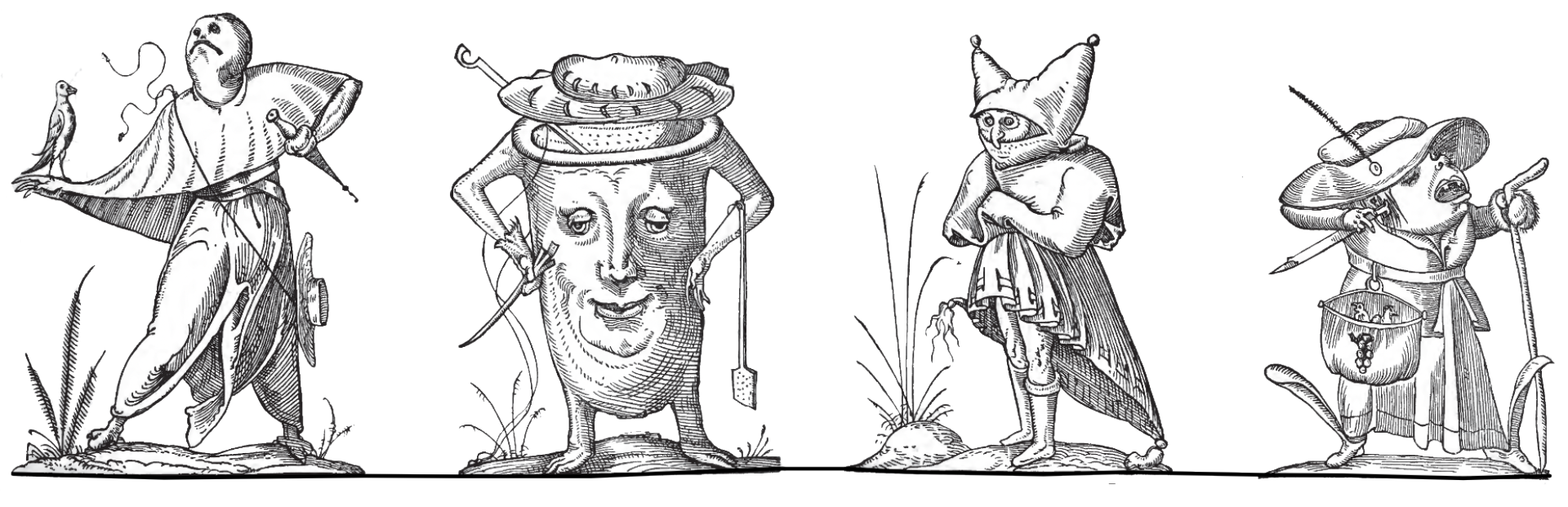
Banner characters extracted from the Internet Archive, and E. Tross, P. Bruegel, discovered by SvG, to whom goes my usual gratitude.
References / notes Link to heading
Gould, S. J. (1980) The Panda's Thumb: More Reflections in Natural History, W. W. Norton & Company.
Mosley, A., Jardine, N., & Tybjerg, K. (2003). Epistolary culture, editorial practices, and the propriety of Tycho's Astronomical letters. Journal for the History of Astronomy, 34(4), 421-451. DOI: 10.1177/002182860303400404, also on ADS.
Ogilvie, B. (2016). Correspondence networks. A Companion to the History of Science, 358-371. DOI: 10.1002/9781118620762.ch25.
Oliveira, J. G., & Barabási, A. L. (2005). Darwin and Einstein correspondence patterns. Nature, 437(7063), 1251-1251. DOI: 10.1038/4371251a, also on https://arxiv.org/abs/physics/0511006.